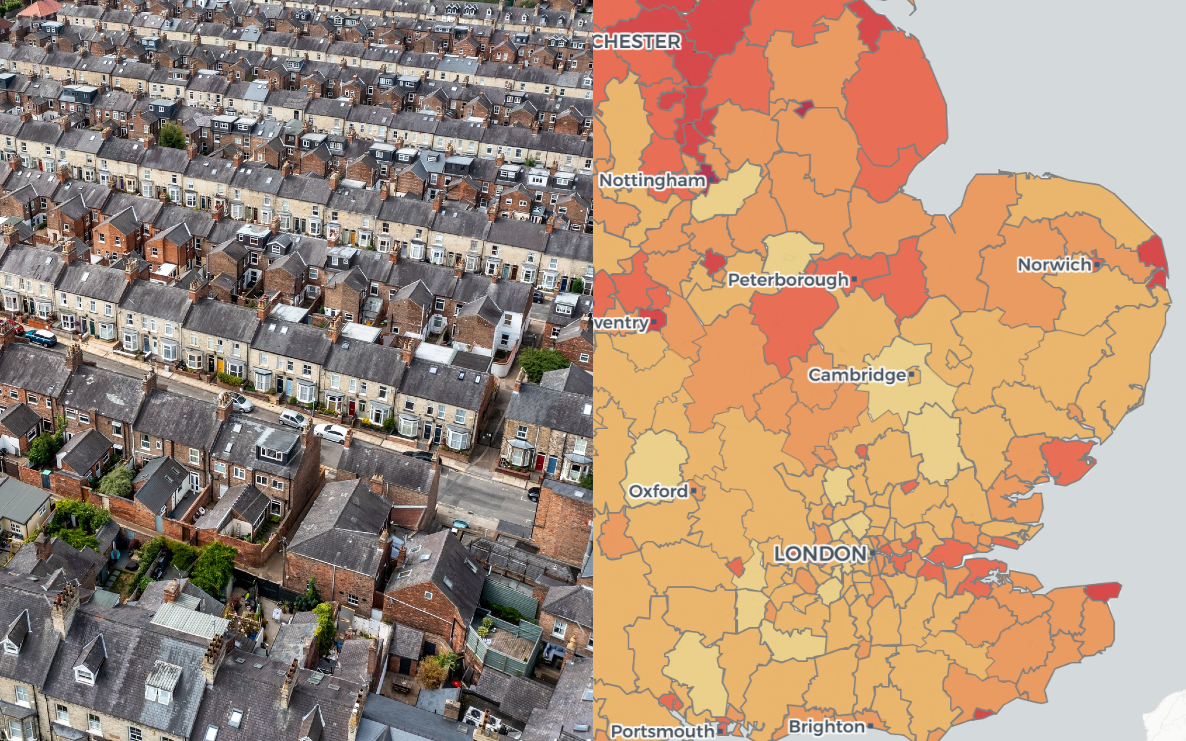
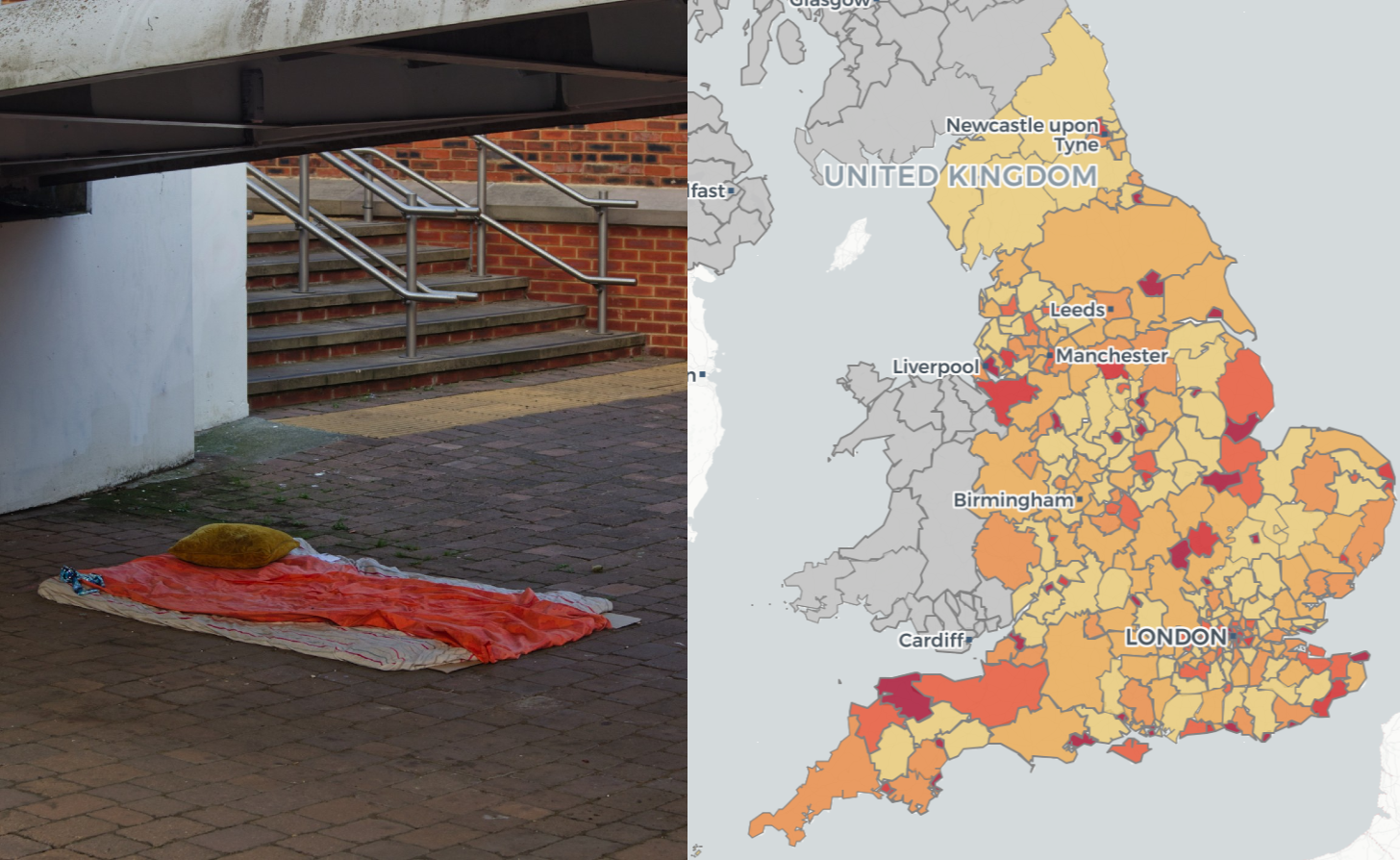
The start of the new year provides a good opportunity to attempt to identify some of the trends and changes we can expect to see in the world of geographical data over the next 12 months.
From deprivation data to AI, open data in the UK and in Europe, here are the data trends to look out for in 2025:
Indices of multiple deprivation update
The English indices of multiple deprivation currently date from 2019 and are overdue an update.
The indices provide a relative measure of deprivation across different geographical areas of the country (down to lower super output area), splitting them into deciles and ranking them across seven different ‘domains’ of deprivation, including income, employment and health.
The Ministry of Housing Communities and Local Government (MHCLG) is working with two external partners to update the indices. In December 2024, OSCI, one of those partners, said “the release of the updated indices is aimed at late 2025.“
Among the changes expected this time around, the new iteration will include co–operation with the Department for Environment, Food and Rural Affairs to improve measures of deprivation in rural areas.
Subnational data strategy
The subnational data strategy was published in December 2021 with a mission to “fill the long-standing gaps in the subnational evidence base.”
The publication of the strategy was an acknowledgement that too much data is published at a regional level at best, leaving holes in the evidence base. It set out an ambitious plan for “subnational by default” through “more timely, granular and harmonised subnational statistics”.
Three years on, the strategy will be updated in 2025 as efforts continue to enable users of these data – central and local government, local businesses, the general public – to “take decisions crucial to the success of these places.”
An ONS spokesperson told Polimapper that the timescale for the update was “still to be confirmed, but likely to be spring”.
Constituency level data on the increase
Prior to the 2024 general election, it was understandably difficult to justify public bodies investing in producing statistics calibrated to parliamentary constituency level.
This is because the 2023 Boundary Review resulted in the redrawing of all bar a handful of constituencies across the UK, so any money and time invested in developing constituency level statistics would be short-lived.
Since the 2024 general election, there are signs that we could see more data published to the current parliamentary constituency boundaries. Defra, for example, in December published statistics on agricultural land use previously only available at local authority level.
With the next boundary review not due until 2031, and the potential for the current boundaries to be in use until an election in 2034 (if the next two governments go for a full term), the investment case for data at a constituency level has significantly strengthened.
Making open data a priority again
A decade ago, the UK was a world leader in open data, with the government described in 2015 as the ‘most transparent’ in the world.
The most recent Open Government Barometer, dating from 2020, showed the UK had slipped back in the five years that followed. The European Open Data Maturity rankings for 2021, the last year the UK was included following Brexit, also showed that it had slipped behind northern European neighbours such as France, Spain and Ireland.
It will be interesting to see how the ‘open data’ agenda develops under the Labour government. The Labour manifesto mentioned the word “data” five times, and they have already started to make good on their pledge to create a “data library”.
The development of a National Data Library was confirmed by the Department for Science, Innovation and Technology in November 2024 with the intention to “provide simple, ethical and secure access to public data assets”.
It was under a previous Labour government that Freedom of Information legislation was enacted, so the current government arguably has big shoes to fill when it comes to ‘open government’.
An increased role of AI
Predicting an increased role of AI in collating and analysing data in 2025 isn’t a particularly bold prediction or one that will win many plaudits.
What’s more difficult is to understand the exact shape that this may take.
On Monday the government unveiled its “AI Opportunities Action Plan”, a whole section of which was devoted to “unlocking data assets in the public and private sector”.
The plan says high quality data is critical to fuelling “both frontier AI progress and high-quality AI applications”.
It also pledged to build on the aforementioned proposals to create a National Data Library, and to uncover new data sources not currently being used to train AI models to encode “new insights about the world”.
Beyond government policy, also expect AI to play an ever-growing part in speeding up data crunching and analysis. Even at a desktop level.
Last year Microsoft researchers made advances in getting AI language models to understand and interpret Excel spreadsheets.
Pan European data sharing
Another project to watch with interest in 2025 is Open Maps for Europe 2 (OME2).
A big difficulty with comparing country level data is navigating issues around the way the different methodologies are used to collate data.
The objective of the OME2 project is to overcome this, and to provide “free-to-use- high-value data from multiple European countries under a single open licence”.
Belgium, France, Spain and the Netherlands were among the initial countries to join the initiative, followed in November by Greece, Latvia, Luxembourg and Slovakia.
Initial datasets to be mapped have focused on administrative boundaries and transport in France, Belgium and the Netherlands.
A prototype covering 10 countries is expected to be available by the end of 2025, that will also feature a hydrography dataset.